
Net Run Rate (NRR) is one of the most important numbers in limited-overs cricket, especially when two or more teams finish with the same number of points in a tournament. Fans often notice NRR next to a team’s name in the points table, but many still wonder what it actually means and how the number is calculated.
In simple terms, net run rate measures how quickly a team scores runs compared with how quickly its opponents score against it. A positive NRR generally means a team has scored runs at a faster rate than its opponents overall, while a negative NRR means the opposition has scored at a faster rate.
NRR is commonly used in league competitions such as One Day Internationals and T20 cricket to separate teams that have equal points. It works in a similar way to goal difference in football, although the two statistics are not calculated in the same way.
What Is Net Run Rate in Cricket?
Net Run Rate, commonly written as NRR, is a statistical method used to compare the scoring and conceding rates of cricket teams in limited-overs competitions.
The basic idea is straightforward. A team’s own run rate is compared with the run rate at which its opponents have scored against it.
The basic formula is:
Net Run Rate = Team’s Run Rate − Opponents’ Run Rate
For example, if a team scores at an average of 8.00 runs per over and its opponents score at 7.00 runs per over, its NRR would be:
8.00 − 7.00 = +1.00
That means the team has a net run rate of +1.00.
If a team scores at 7.20 runs per over but concedes runs at 8.10 runs per over, its NRR would be:
7.20 − 8.10 = −0.90
Therefore, the higher the NRR, the better the team’s overall scoring rate compared with its opponents.
How Is Net Run Rate Calculated?
The calculation of NRR is based on the runs scored, runs conceded and the number of overs involved in the relevant innings.
For a single completed match, the simplified calculation is:
NRR = (Runs scored ÷ Overs faced) − (Runs conceded ÷ Overs bowled)
Suppose Team A scores 180 runs in 20 overs and Team B scores 160 runs in 20 overs.
Team A’s run rate:
180 ÷ 20 = 9.00
Team B’s run rate:
160 ÷ 20 = 8.00
Therefore:
NRR = 9.00 − 8.00 = +1.00
Team A would have a match NRR of +1.00, while Team B would have an NRR of −1.00 for that particular match.
However, tournament NRR is not normally calculated simply by adding or averaging the NRR figures from individual matches. Instead, the overall runs and overs across the relevant matches are used to determine the team’s tournament run rate and the opponents’ run rate.
How Is Tournament Net Run Rate Calculated?
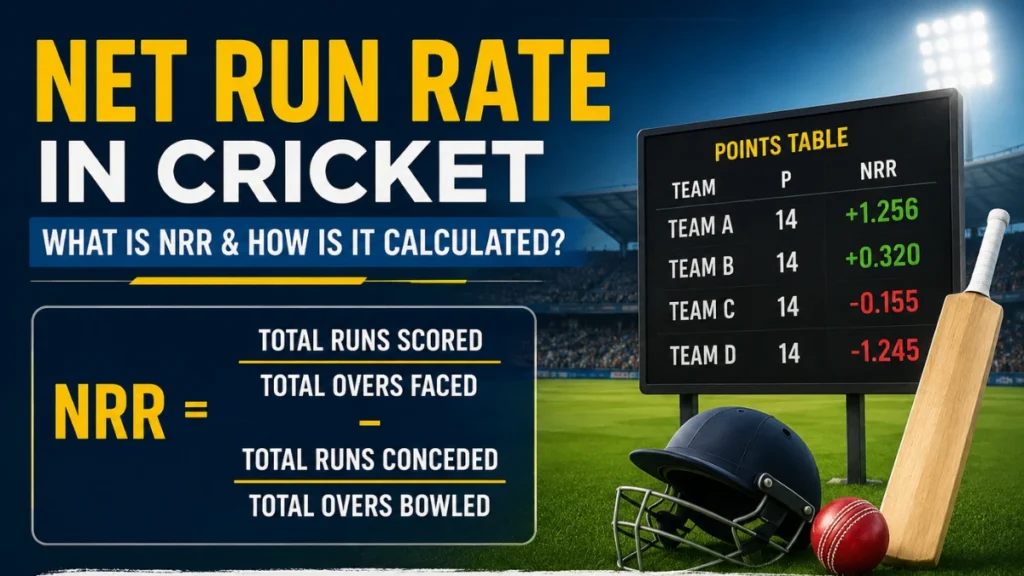
Tournament NRR is slightly more complicated than calculating NRR for one match.
The overall tournament formula can be written as:
NRR = (Total runs scored ÷ Total overs faced) − (Total runs conceded ÷ Total overs bowled)
This means all relevant innings from the tournament are considered together.
For example, imagine a team plays three matches:
- Match 1: Scores 180 in 20 overs
- Match 2: Scores 160 in 20 overs
- Match 3: Scores 200 in 20 overs
The team has scored:
180 + 160 + 200 = 540 runs
And it has faced:
20 + 20 + 20 = 60 overs
Its overall scoring rate would therefore be:
540 ÷ 60 = 9.00 runs per over
The same calculation is then performed using the runs conceded and overs bowled. The difference between those two overall rates gives the team’s tournament NRR.
This is why averaging the NRR figures from individual matches can produce a different answer from the official tournament NRR.
Why Is Net Run Rate Important in Cricket?
NRR becomes particularly important when teams finish a league stage with the same number of points.
In a tournament, teams normally receive points for wins and sometimes for ties or no-results, depending on the competition’s rules. If two teams have the same number of points, a tie-breaker is needed to decide their positions.
This is where net run rate can become crucial.
A team with a higher NRR may finish above another team with the same number of points. In a closely contested tournament, even a small difference in NRR can determine which team reaches the next stage and which team is eliminated.
This makes every run and every over potentially important.
Aso read: Cricket World Cup Winners: Complete History of Every ICC Men’s Cricket World Cup Champion
What Does a Positive Net Run Rate Mean?
A positive NRR means a team has scored runs at a faster overall rate than its opponents.
For example:
Team’s scoring rate: 8.50
Opposition scoring rate: 7.75
NRR: +0.75
A positive number is generally considered desirable because it indicates that the team’s overall scoring rate has been better than the rate at which its opponents have scored against it.
However, a positive NRR does not automatically mean that a team has won every match. A team can have a positive NRR despite suffering defeats, depending on the results and margins across the tournament.
What Does a Negative Net Run Rate Mean?
A negative NRR means that the opposition has scored at a faster rate than the team overall.
For example:
Team’s scoring rate: 7.40
Opposition scoring rate: 8.00
NRR: −0.60
A negative NRR can become a problem in a league table when teams are level on points.
This is why teams sometimes need not only to win matches but also to win them by a strong margin, particularly near the end of a league stage.
Aso read: DLS Method in Cricket: What Is Duckworth-Lewis-Stern Method and How Does It Work?
Does Winning by a Bigger Margin Improve NRR?
Generally, yes.
If a team wins comfortably by scoring quickly and restricting the opposition’s scoring rate, its NRR can improve significantly.
For example, winning a T20 match by scoring 200 while restricting the opposition to 150 can produce a much better NRR impact than a narrow win in which a team scores 160 and concedes 159.
However, NRR is not simply a measure of the size of a team’s victory.
One important criticism of NRR is that it measures scoring rates rather than directly measuring the margin of victory. It also does not account for wickets lost in the same way that a simple margin-based statistic would. As a result, a team progressing because of a superior NRR has not necessarily been the team with the largest margins of victory.
Why NRR Can Be Difficult to Understand
At first glance, NRR looks like a simple calculation, but tournament situations can make it more complicated.
A common misunderstanding is that a team’s tournament NRR is calculated by adding the NRR from every match and dividing by the number of matches.
That is not normally how it works.
The calculation considers the total runs and overs across the relevant innings. In other words, the run rates are effectively weighted according to the lengths of the innings involved.
This distinction becomes particularly important when matches do not last the full number of available overs.
What Happens When a Team Is Bowled Out?
There is an important detail when calculating NRR.
If a team is bowled out before using all of its allocated overs, the calculation does not simply treat the innings as though the team had only faced the number of overs it actually completed.
For example, if a team is bowled out for 120 after 17.3 overs in a 20-over match, the NRR calculation rules can use the full 20-over allocation for that innings rather than allowing the team to benefit from being dismissed early.
This prevents a team from gaining an artificial advantage in the calculation simply because it lost all its wickets before the allotted overs were completed.
The precise calculation can also depend on the competition regulations.
Does NRR Apply to Test Cricket?
Net run rate is primarily associated with limited-overs cricket, where innings have a predetermined number of overs.
It is commonly used in formats such as:
- One Day International cricket
- T20 International cricket
- Domestic T20 competitions
- Domestic limited-overs tournaments
Test cricket generally does not use NRR as its standard league-table tie-breaker because Test matches are not restricted to a fixed number of overs in the same way.
Cricket statistics also distinguish NRR from other measures such as batting average, strike rate, bowling average and economy rate.
Aso read: Most Expensive Over Bowled in Test Cricket: Jasprit Bumrah Hits Stuart Broad for 35 at Edgbaston
Net Run Rate vs Run Rate
Run rate and net run rate are related, but they are not the same thing.
Run rate refers to the average number of runs scored per over by a batting side.
Net run rate compares a team’s scoring rate with the scoring rate of its opponents.
For example:
Run rate = Runs scored ÷ Overs faced
Whereas:
Net run rate = Team run rate − Opposition run rate
A team’s run rate therefore tells you how quickly it is scoring, while its NRR gives a broader picture of how its scoring rate compares with its opponents.
Net Run Rate vs Required Run Rate
Another term that often causes confusion is required run rate, or RRR.
Required run rate is the scoring rate a batting team needs to maintain to reach its target within the remaining overs of a match. It is mainly used during a run chase.
For example, if a team needs 60 runs from 6 overs, its required run rate is:
60 ÷ 6 = 10 runs per over
That is different from NRR, which is mainly used to compare teams across a tournament.
When Was Net Run Rate Introduced in the Cricket World Cup?
Net run rate has been used as a tournament tie-breaker in major limited-overs cricket.
According to the Wikipedia reference, the 1992 Cricket World Cup was the first World Cup to use NRR. Earlier editions had used run rate as a tie-breaker.
Since then, NRR has become a familiar part of limited-overs cricket, particularly during group stages when teams are separated by only a few points.
Why Teams Try to Improve Their NRR
When qualification depends on NRR, a team may have an incentive to win by a bigger margin rather than simply securing a narrow victory.
For a batting side, scoring runs quickly can help increase its scoring rate. For a bowling side, restricting the opposition to a low total can reduce the opponent’s scoring rate.
This is particularly noticeable near the end of a group stage. A team may already know that a win is important, but it may also need a certain margin to improve its NRR enough to overtake another team.
That is one reason cricket fans sometimes watch the final overs of a match even after the likely winner appears clear.
conclusion
Net Run Rate is one of the most important statistical tools in limited-overs cricket. It gives tournaments a method for separating teams that finish with equal points and rewards strong scoring rates while penalising teams that regularly concede runs quickly.
The basic concept is simple: compare the rate at which a team scores runs with the rate at which its opponents score against it.
However, the official tournament calculation is more detailed than simply averaging individual match NRR figures. It considers the overall runs and overs involved across the relevant matches.
NRR is not a perfect measurement of team strength, and it does not directly show the size of victories or defeats. Even so, it remains an important part of modern limited-overs cricket and can sometimes make the difference between qualification and elimination.
For fans following a tight tournament points table, understanding net run rate can make the competition much easier to follow. A few extra runs scored quickly, or a few runs saved by the bowling side, can ultimately have a major impact on a team’s position.