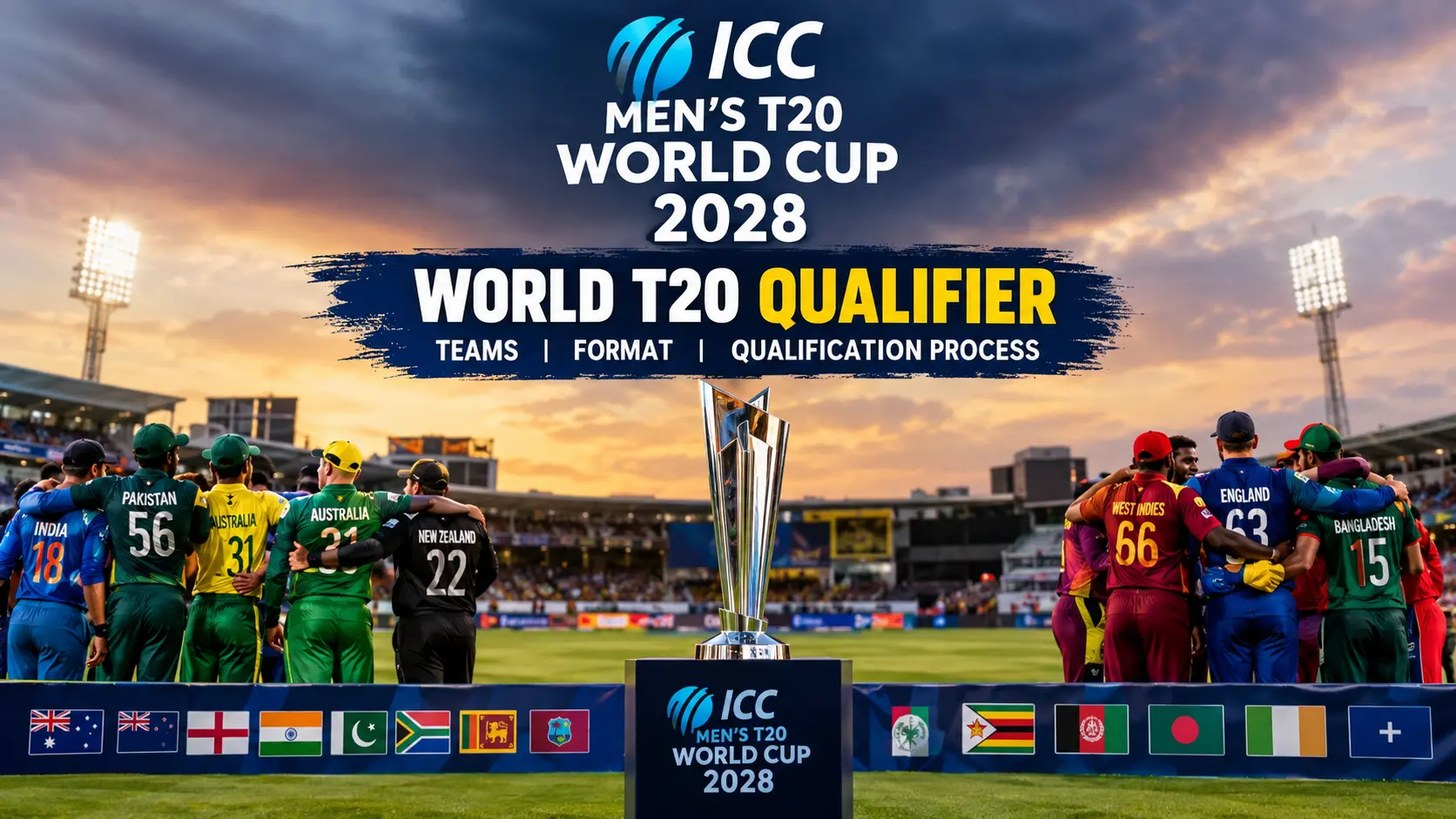
World T20 Qualifier 2028:The world t20 qualifier will play an important role in deciding the remaining teams for the 2028 ICC Men’s T20 World Cup, which will be jointly hosted by Australia and New Zealand from October 21 to November 19, 2028. The tournament will be the 11th edition of the ICC Men’s T20 World Cup, featuring international teams competing in the Twenty20 International (T20I) format.
The qualification pathway for the 2028 tournament includes three main stages: direct qualification, regional qualification and the Global Qualifier. The International Cricket Council (ICC) confirmed the return of the Men’s T20 World Cup Global Qualifier in July 2026, bringing back a key stage that was part of the qualification pathway through the 2022 edition.
With 20 teams expected to participate in the 2028 T20 World Cup, the qualification process will give established cricket nations and emerging teams an opportunity to compete for a place on the sport’s biggest T20 stage. Teams that do not qualify directly will have to perform well in regional competitions and, where applicable, the Global Qualifier to secure their place.
This guide explains the world t20 qualifier format, the three qualification stages, regional slots, automatically qualified teams and the latest qualification information provided for the 2028 tournament.
World T20 Qualifier 2028: Overview
The following table summarises the key details of the 2028 ICC Men’s T20 World Cup and its qualification pathway.
| Detail | Information |
|---|---|
| Tournament | ICC Men’s T20 World Cup 2028 |
| Edition | 11th |
| Format | Twenty20 International (T20I) |
| Hosts | Australia and New Zealand |
| Start date | October 21, 2028 |
| Final date | November 19, 2028 |
| Organising body | International Cricket Council (ICC) |
| Total teams | 20 |
| Qualification stages | Direct, regional and Global Qualifier |
| Global Qualifier | 16 teams |
| Regional qualification participants | 80 teams, according to the supplied data |
| Qualification announcement | July 2026 |
The tournament will be particularly significant for New Zealand, which is set to host the Men’s T20 World Cup for the first time. Australia, meanwhile, previously hosted the competition in 2022.
What Is the World T20 Qualifier?
The world t20 qualifier is the qualification pathway through which teams compete for places in the ICC Men’s T20 World Cup. It provides a route for countries that have not secured automatic qualification to reach the global tournament through regional competitions and the final Global Qualifier.
For the 2028 edition, the ICC has confirmed a 20-team World Cup and an updated qualification system. Twelve teams have already secured their places based on their performances in the 2026 T20 World Cup and the ICC Men’s T20I Team Rankings. The remaining eight places will be decided through the regional qualification pathway and a 16-team Global Qualifier.
This system gives teams from Africa, Asia, Europe, the Americas and the East Asia-Pacific region a chance to progress. It also allows emerging cricket nations to compete against stronger international sides and gain valuable experience.
World T20 Qualifier 2028: How Does the Qualification Process Work?
The qualification process has three main stages. Each stage serves a different purpose, from confirming the places of the highest-performing teams to determining which emerging nations advance to the final qualifying competition.
1. Direct Qualification
Direct qualification is the first stage of the pathway. Teams can secure their places through their performance in the previous T20 World Cup or their position in the ICC Men’s T20I Team Rankings.
For the 2028 tournament, Australia and New Zealand qualify automatically as co-hosts. Teams that reached the Super Eights of the 2026 T20 World Cup also secured automatic qualification, while the remaining automatic places were awarded to the next three highest-ranked teams at the specified ranking cut-off.
This process confirmed 12 teams for the 2028 event. It means these teams do not need to compete in the regional qualifiers or the Global Qualifier to earn their World Cup places.
2. Regional Qualification
Regional qualification is the next stage for teams that have not qualified directly. It is designed to identify the strongest contenders from different cricketing regions.
The regional pathway includes sub-regional qualifiers and regional finals. Depending on the region, teams compete in round-robin matches, group stages or knockout fixtures. Their results determine which sides advance to the next stage.
The sub-regional competitions are particularly important for associate cricket nations. Teams that perform well can move closer to the Global Qualifier, where they will face opponents from other parts of the world.
The ICC has allocated eight places in the 16-team Global Qualifier to regional qualification:
| ICC Region | Teams Advancing to Global Qualifier |
|---|---|
| Africa | 2 |
| Asia | 2 |
| Europe | 2 |
| Americas | 1 |
| East Asia-Pacific | 1 |
| Total | 8 |
These regional places will be combined with eight teams that have already been assigned places in the Global Qualifier, creating a 16-team competition.
3. Global Qualifier
The Global Qualifier is the final qualifying stage before the 2028 ICC Men’s T20 World Cup. It brings together teams that missed out on direct qualification and those that progressed through the regional pathway.
The ICC confirmed the return of this stage in July 2026. Its reintroduction restores an important part of the qualification system that was used through the 2022 edition.
A total of 16 teams are expected to compete for the remaining eight World Cup places. Under the announced system, the highest-placed team from each region will qualify, along with the next three highest-placed teams overall, subject to minimum performance criteria.
This makes the Global Qualifier a crucial competition. A team might dominate its regional tournament but still need to perform consistently against international opposition to secure a World Cup place.
World T20 Qualifier: Teams Already Qualified for the 2028 T20 World Cup
As of October 8, 2026, 12 teams have secured their places in the 2028 ICC Men’s T20 World Cup. The confirmed list includes the two co-hosts, teams that reached the Super Eights in 2026 and the three highest-ranked teams that completed the automatic qualification list.
| No. | Team | Qualification Method | Previous T20 World Cup Best |
|---|---|---|---|
| 1 | Australia | Co-host | Winners (2021) |
| 2 | New Zealand | Co-host and Super Eights | Runners-up (2021, 2026) |
| 3 | England | Super Eights (2026) | Winners (2010, 2022) |
| 4 | India | Super Eights (2026) | Winners (2007, 2024, 2026) |
| 5 | Pakistan | Super Eights (2026) | Winners (2009) |
| 6 | South Africa | Super Eights (2026) | Runners-up (2024) |
| 7 | Sri Lanka | Super Eights (2026) | Winners (2014) |
| 8 | West Indies | Super Eights (2026) | Winners (2012, 2016) |
| 9 | Zimbabwe | Super Eights (2026) | Super Eights (2026) |
| 10 | Afghanistan | ICC T20I Team Rankings | Semi-finalists (2024) |
| 11 | Bangladesh | ICC T20I Team Rankings | Super Eights (2007, 2024) |
| 12 | Ireland | ICC T20I Team Rankings | Super Eights (2009) |
Source: ICC qualification announcements. Previous best performances refer to the Men’s T20 World Cup.
These 12 teams can now prepare for the 2028 competition without worrying about the remaining qualification rounds. The other eight places will be decided through the Global Qualifier.
For teams such as India, Australia, England, Pakistan and the West Indies, the focus will be on preparing a competitive squad for the tournament. For emerging nations, the world t20 qualifier pathway will be an opportunity to join cricket’s biggest T20 international competition.
Regional Qualifiers for the 2028 T20 World Cup
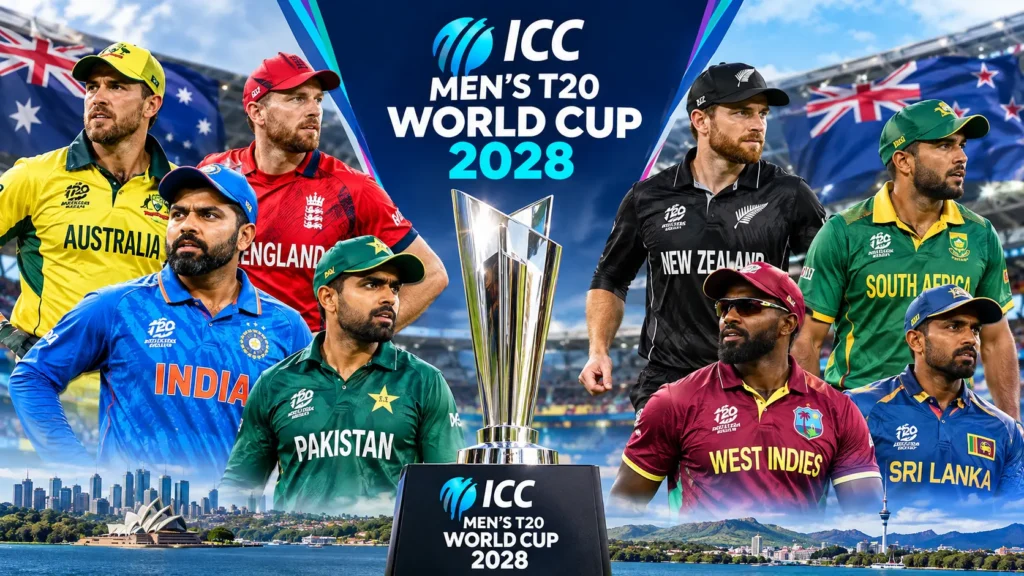
The regional competitions are an essential part of the qualification process. They give teams that are not among the automatic qualifiers a structured route to the Global Qualifier.
Africa Qualifier
African teams will compete for two places in the Global Qualifier. The regional pathway includes preliminary competitions, followed by the relevant qualifying stage for teams that advance.
The competition will give African cricket nations an opportunity to test their strength against regional opponents and compete for a place in the final qualification event.
Asia Qualifier
Asia has been allocated two places in the Global Qualifier. The sub-regional competitions are already part of the road to the 2028 tournament.
In October 2026, Malaysia is hosting the Asia Sub-Regional Qualifiers A and B from October 5 to 14. A total of 13 teams are competing across three venues, with six qualification places available for the next stage in 2027. The teams are divided into two groups, and the top three from each group will progress.
These matches are important for associate nations seeking to move closer to the main World Cup. Progress at the sub-regional level can open the door to tougher regional competition and, eventually, the Global Qualifier.
Europe Qualifier
Europe will receive two places in the Global Qualifier. Its pathway includes multiple sub-regional competitions, allowing teams to compete for progression to the European qualifying stage.
Scotland has been granted direct entry into the Europe Regional Final because of the exceptional circumstances surrounding its participation in the 2026 tournament. Other teams must progress through the applicable qualification rounds.
Americas Qualifier
The Americas region has one place in the Global Qualifier. Teams from the region must perform well in their qualifying competitions to secure that opportunity.
With only one regional place available, every match can have a major impact on a team’s chances of advancing.
East Asia-Pacific Qualifier
The East Asia-Pacific region also has one place in the Global Qualifier. The competition offers a pathway for teams from this part of the cricket world to challenge for a position in the 2028 T20 World Cup.
Strong performances in the regional rounds will be necessary for teams hoping to progress to the final qualifying stage.
Scotland’s Special Qualification Route
One notable detail in the 2028 qualification pathway is Scotland’s direct entry into the Europe Regional Final.
According to the ICC’s announcement, this arrangement recognises the exceptional circumstances surrounding Scotland’s participation in the 2026 T20 World Cup. It provides Scotland with a different route through the European qualification system.
This special provision does not mean Scotland has already qualified for the 2028 World Cup. The team must still perform well enough in the remaining stages to earn its place in the Global Qualifier and then meet the requirements for World Cup qualification.
Why Is the World T20 Qualifier Important?
The world t20 qualifier is important because it gives teams outside the established group of international cricket powers a realistic route to the World Cup.
First, it creates opportunities for developing cricket nations. Teams that might not regularly face the world’s strongest sides can earn the chance to compete on a global stage.
Second, the qualification process encourages consistent performances. Teams need to win important matches, handle pressure and adapt to different playing conditions to progress through the rounds.
Third, qualification can help grow cricket in emerging markets. A place in the T20 World Cup gives a country greater international exposure and creates opportunities for players to compete against leading teams.
Finally, the Global Qualifier brings together teams from different regions. This creates a demanding final hurdle in which a strong regional record must be followed by another series of competitive performances.
What Happens After the Global Qualifier?
Once the Global Qualifier concludes, the eight successful teams will join the 12 automatic qualifiers to complete the 20-team lineup for the 2028 ICC Men’s T20 World Cup.
The tournament will be held in Australia and New Zealand from October 21 to November 19, 2028. The ICC has also announced a revised playing format for the competition.
Under the updated format, the 20 teams will begin in five groups of four. The top two teams from each group will progress to the Super 10 stage, which will consist of two groups of five. The winners of those groups will qualify directly for the semi-finals, while the remaining semi-finalists will be decided through an eliminator round.
This revised structure is designed to make the tournament more competitive and give more teams a chance to progress beyond the opening stage.
For teams coming through the Global Qualifier, reaching the World Cup will be only the beginning. They will then need to compete against some of the strongest sides in international cricket.
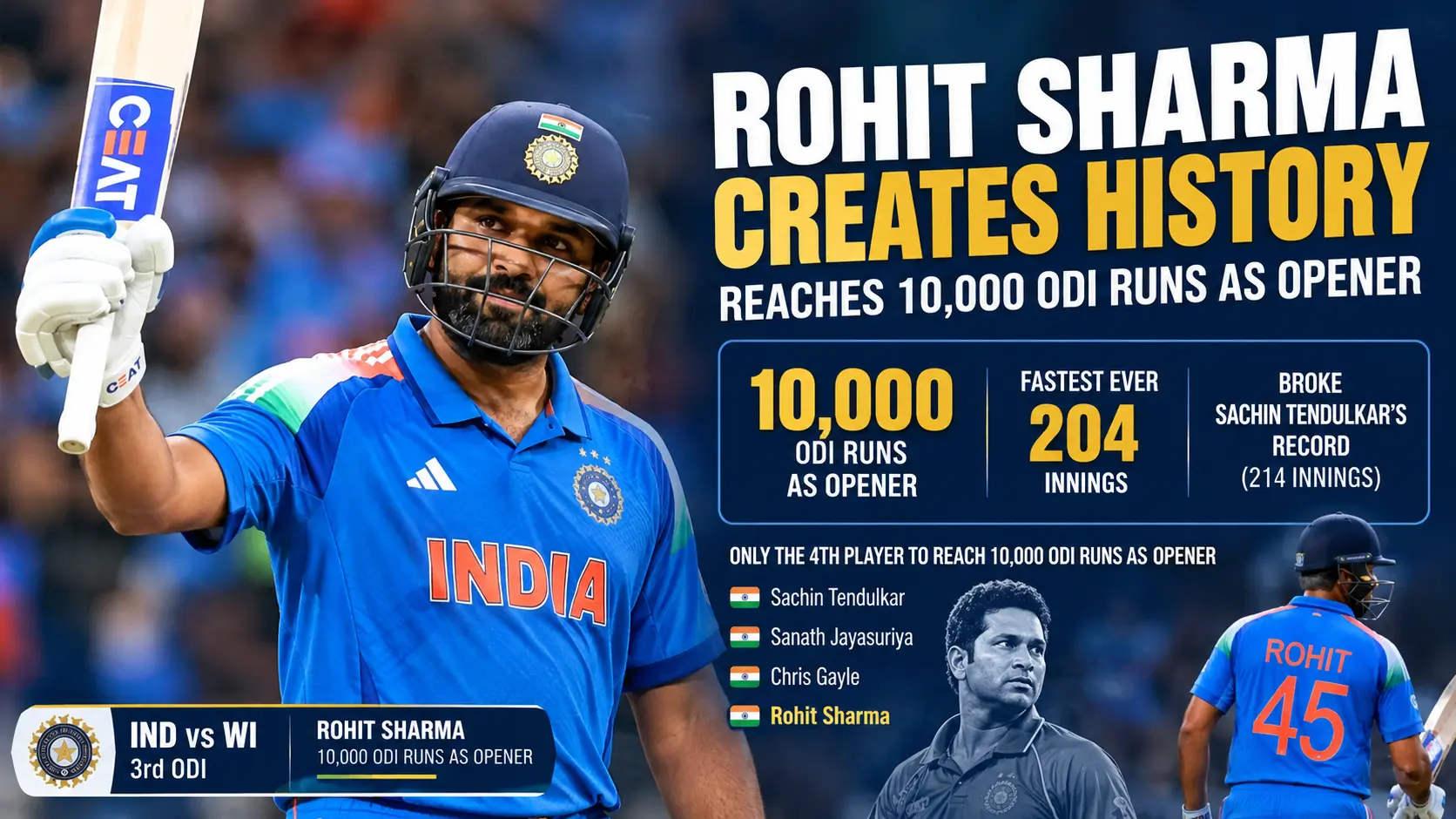
Also read: IND vs WI: Rohit Sharma Creates History, Reaches 10,000 Runs and Leaves the Cricket World Amazed
Conclusion
The world t20 qualifier 2028 will be a major part of the journey towards the next ICC Men’s T20 World Cup. With 12 teams already qualified and eight places still available, the regional competitions and Global Qualifier will determine the final lineup for the tournament in Australia and New Zealand.
The qualification system combines automatic entry for leading teams with opportunities for countries that must earn their place through regional competition. From the Asia qualifiers to the European pathway and the final Global Qualifier, every stage will matter for teams chasing a place at the global event.
For cricket fans, the road to 2028 offers plenty to follow, especially as emerging nations attempt to challenge established teams. The remaining qualification rounds will reveal which eight sides can complete the 20-team lineup and compete at the 2028 ICC Men’s T20 World Cup.