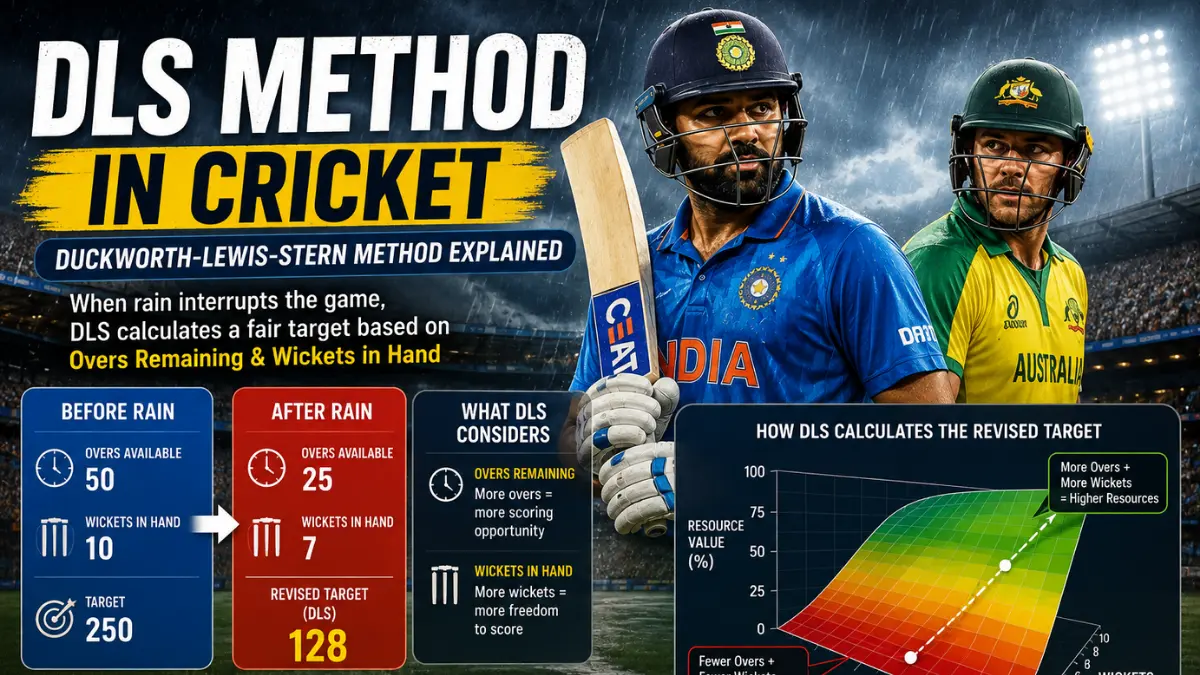
When rain interrupts a cricket match, the entire game can change within minutes. A team that was comfortably chasing a target may suddenly find itself with fewer overs, while the target can also change. This is where the DLS Method becomes important.
The DLS Method, short for Duckworth-Lewis-Stern Method, is a mathematical system used in limited-overs cricket to calculate a revised target when rain or another interruption reduces the amount of play available.
But DLS is not simply about cutting runs because some overs have been lost.
The method tries to answer a much more important question: How much scoring opportunity does the chasing team actually have left?
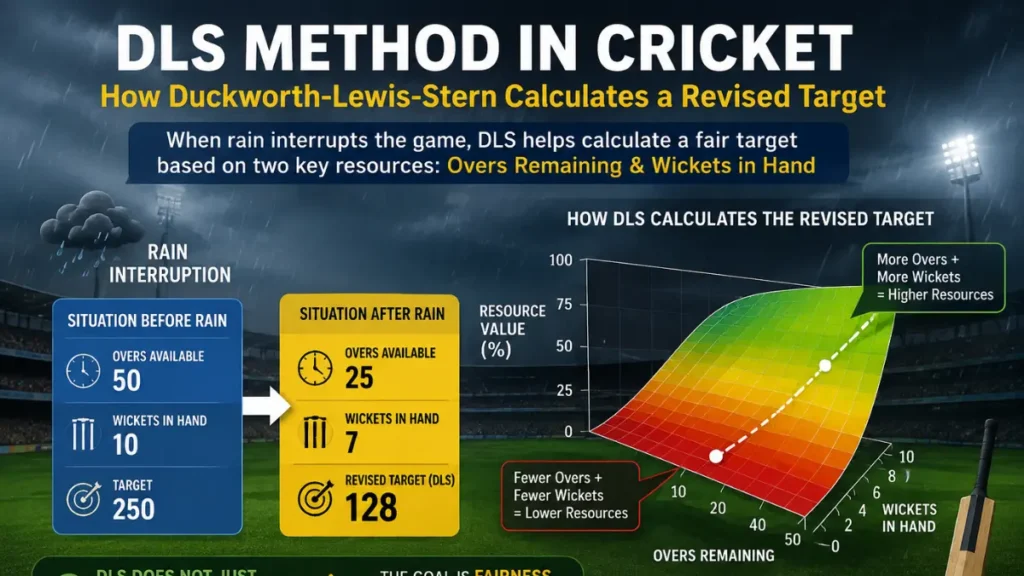
To make that assessment, the DLS Method considers two major batting resources — overs remaining and wickets in hand.
That is what makes DLS different from simply reducing a target by a fixed percentage.
What Is the DLS Method in Cricket?
The DLS Method is a mathematical calculation used to set or revise a target in a limited-overs cricket match when an interruption affects the available playing time.
In a normal 50-over match, if Team A scores 250 runs, Team B needs 251 runs to win.
However, imagine Team B starts its chase and rain arrives after only a few overs. If the match can no longer be completed over the original 50 overs, officials need to calculate a new target.
This is where DLS comes in.
The method considers the resources still available to the chasing side, particularly:
| Resource | Why it matters |
|---|---|
| Overs remaining | Determines how much time the batting team has to score |
| Wickets remaining | Indicates how much freedom the batters have to take risks |
A team with 10 wickets and plenty of overs has a very different scoring potential from a team with 3 wickets and only a few overs remaining.
Human analysis: Why this matters
This is the most important thing fans should understand about DLS.
Suppose two teams both have 20 overs remaining. One team has lost only one wicket, while the other has already lost seven wickets.
On paper, both teams have the same number of overs.
But their situations are clearly not the same.
The team with more wickets can attack harder because it has greater batting depth. The team with seven wickets down has to be much more careful.
DLS tries to reflect that difference instead of treating every remaining over as having the same value.
Why Was the DLS Method Introduced?
Before DLS became the standard approach, cricket used other methods to calculate revised targets after rain interruptions.
Two of the better-known approaches were the Average Run Rate method and the Most Productive Overs method.
The problem was that these systems did not properly capture the changing balance of a cricket innings.
Average Run Rate method
The Average Run Rate approach focused mainly on how quickly a team had scored.
That created a potential weakness.
A batting team expecting rain could theoretically benefit from scoring very aggressively before an interruption. The system did not adequately account for the relationship between scoring rate and wickets lost.
Most Productive Overs method
The Most Productive Overs method had a different problem.
It could ignore the best-scoring overs of the first innings while calculating the revised target. As a result, a team could potentially be penalised because it had played some particularly productive overs.
Neither approach fully captured the real match situation.
That created the need for a more sophisticated system.
The 1992 World Cup Match That Highlighted the Problem
One of the most famous moments connected with the development of the DLS Method came during the 1992 Cricket World Cup semi-final between England and South Africa.
South Africa were chasing England’s target when rain interrupted the match.
Before the interruption, South Africa needed 22 runs from 13 balls.
After the rain delay, their revised situation became dramatically different: they needed 21 runs from only one ball.
That was an extremely difficult target and highlighted a major problem with the system being used at the time.
Losing playing time had barely reduced the number of runs required, but it had removed almost all of the deliveries available to score those runs.
Why was this incident so important?
The incident showed that a rain-revision system could not simply manipulate runs and overs without considering the actual resources available to a batting side.
The controversy became one of the important inspirations behind the search for a better mathematical solution.
Frank Duckworth later became interested in solving the problem mathematically, eventually working with Tony Lewis on what became the Duckworth-Lewis method.
How Does the DLS Method Work?
At its simplest level, the DLS Method looks at the batting resources available to a team.
The two key resources are:
- Overs remaining
- Wickets remaining
The combination of these factors determines how much scoring potential remains.
For example:
- 40 overs + 10 wickets = huge batting resources
- 20 overs + 10 wickets = fewer resources
- 20 overs + 5 wickets = considerably fewer resources
- 10 overs + 2 wickets = very limited resources
The important point is that overs and wickets work together.
You cannot understand the DLS Method properly by looking at overs alone.
DLS Method Is Not Simply a Reduction in Overs
This is one of the biggest misconceptions among cricket fans.
Suppose a team is originally supposed to chase a target over 50 overs.
Rain reduces the chase to 25 overs.
It would be tempting to think:
“There are half the overs, so the target should simply become half.”
But cricket does not work that way.
A team batting for only 25 overs knows from the beginning that it has limited time. Batters can therefore adopt a much more aggressive approach.
If wickets are available, they can take calculated risks because there are still batters waiting in the dressing room.
This changes the scoring pattern.
Practical example
Imagine Team A scores 250 in 50 overs.
Team B’s chase is reduced to 25 overs.
Team B does not necessarily need a simple 125-run target.
Why?
Because Team B can use its 10 wickets differently in a 25-over chase. Batters can attack from the beginning rather than building an innings slowly over 50 overs.
That is why DLS looks at remaining resources, rather than just chopping the original target in half.
Why Do Wickets Matter So Much in DLS?
Wickets are one of the most important parts of the DLS calculation.
A team with all 10 wickets available has much greater freedom to attack.
For example, imagine a side needs 100 runs from its final 10 overs.
If it has 9 wickets in hand, the batters can play aggressively. Even if one or two players get out, there are still recognised batters available.
Now imagine the same situation with only two wickets remaining.
The strategy changes completely.
The batting team cannot take the same risks because another wicket could effectively end the chase.
This is why two teams with the same number of overs remaining can have very different resource situations.
The simple takeaway
More wickets + more overs = greater batting resources.
Fewer wickets + fewer overs = lower batting resources.
DLS attempts to quantify this relationship mathematically.
DLS Method: A Simple Cricket Example
Let’s take a simple hypothetical situation.
Team A bats first and scores 260 runs in its allotted 50 overs.
Team B starts the chase.
After 15 overs, Team B is 70/2 when rain stops play.
If the match can resume, but only 20 overs are available for Team B instead of the original 35, the target may need to be revised.
Officials cannot simply say:
“Team B lost 15 overs, so remove 30% from the target.”
Instead, the DLS calculation considers Team B’s situation at the interruption:
- How many overs remain?
- How many wickets are still available?
- How much batting resource has been lost?
- How much resource remains?
The revised target is then calculated from those resource values.
Why the target can sometimes change again
This is also why fans may see the target change more than once during a rain-affected match.
If play resumes and another interruption occurs, the team’s resource position has changed again.
The DLS calculation can therefore be performed again.
That is not an error.
It simply reflects the fact that the match situation has changed.
When Was the DLS Method First Used?
The DLS system has its roots in the work of Frank Duckworth and Tony Lewis.
According to the supplied source material, the method entered international cricket on 1 January 1997, when it was used during the second ODI of the Zimbabwe vs England series. Zimbabwe won that match by seven runs.
The method was subsequently adopted by the ICC in 1999 as the standard approach for revised targets in rain-shortened one-day matches.
This was a major change for limited-overs cricket.
Instead of depending on relatively simple run-rate calculations, officials had a mathematical framework that considered the resources available to the batting side.
Duckworth-Lewis Becomes Duckworth-Lewis-Stern
The original system was developed by Frank Duckworth and Tony Lewis.
Later, Australian statistician Steven Stern became responsible for the method after Duckworth and Lewis retired. The method was subsequently renamed the Duckworth-Lewis-Stern method, or simply DLS Method.
The modern version was refined to better reflect changes in limited-overs cricket.
This was particularly important because cricket had become increasingly aggressive.
A 50-over innings in modern cricket does not look the same as one played decades ago. Scoring rates have increased, power-hitting has become more common and teams are generally more willing to take risks.
The DLS system therefore needed to evolve with the sport.
DLS Method in Modern Cricket
Today, the DLS Method is a familiar part of rain-affected limited-overs cricket.
It can become particularly important in:
- ODI matches
- T20 matches
- Knockout games
- Tournament matches
- Matches where rain repeatedly interrupts play
The impact can be huge.
A team may spend hours preparing for a full-length match, only to discover that the chase has been reduced to 20 or 15 overs.
Suddenly, the batting strategy changes.
Powerplay overs become even more valuable. Batters may attack earlier. Bowlers may have less margin for error. Every wicket becomes more important.
This is why DLS is not just a mathematical calculation sitting somewhere in the match software.
It can completely change the tactical direction of a cricket match.
DLS Method and Match Strategy
One interesting aspect of DLS is how it influences the way players approach a shortened chase.
Imagine a team has 15 overs to score a revised target.
The captain cannot use the same strategy that would be used over 50 overs.
There is little value in spending too much time settling in.
Batters need to maximise the available overs, while bowlers try to create early breakthroughs.
This creates an interesting balance:
Wickets are valuable because they preserve batting resources, but overs are also valuable because they cannot be recovered.
That is why DLS can make a rain-shortened match feel completely different from the original contest.
DLS Method vs Old Rain Rules
| Feature | Average Run Rate | Most Productive Overs | DLS Method |
| Considers overs | Yes | Yes | Yes |
| Considers wickets | Limited/No | No | Yes |
| Considers batting resources | No | No | Yes |
| Handles changing match situations | Limited | Limited | Better |
| Designed for rain interruptions | Yes | Yes | Yes |
| More closely reflects modern limited-overs cricket | No | No | Yes |
The major advantage of DLS is that it does not treat an innings as simply a collection of overs.
It recognises that the value of an over depends partly on the wickets available to the batting side.
Why Does DLS Sometimes Feel Unfair to Fans?
Even though DLS is designed to create a fairer contest, fans do not always find the revised targets easy to understand.
That is understandable.
A casual viewer may see a team score 200 runs and then wonder why the chasing side has suddenly been given a target that does not appear proportional to the overs lost.
The reason is that the calculation is based on resource percentages rather than a simple “runs per over” formula.
There is another reason DLS can feel surprising: the target depends on the exact point at which the interruption occurs.
A rain break after five overs is not the same as a rain break after 35 overs.
Likewise, a team that is 120/1 is not in the same resource position as a team that is 120/6.
So when the revised target looks unexpected, it does not necessarily mean the calculation is wrong.
It means the match circumstances are different.
Why the DLS Method Is Important
Rain is something cricket cannot control.
A match can be perfectly balanced one minute and completely transformed by weather the next.
Without a proper revision system, one team could gain a major advantage simply because rain happened to arrive at the wrong time.
The DLS Method attempts to minimise that problem by calculating a target according to the batting resources available.
Its central principle is simple:
A revised target should reflect the resources available to the chasing team.
That idea is what makes DLS such an important part of modern limited-overs cricket.
What Cricket Fans Should Remember About DLS
You do not need to understand every mathematical table behind the DLS Method to understand its basic logic.
Just remember these three things:
1. Overs are a resource
The more overs a batting team has, the more opportunities it generally has to score.
2. Wickets are a resource
The more wickets a team has in hand, the more freedom it has to take risks.
3. Rain changes resources
When rain removes playing time, the team’s available resources change.
DLS uses those changes to calculate a revised target.
Final Analysis: Is DLS Actually Fair?
The biggest strength of the DLS Method is that it recognises something simple but often ignored: a cricket innings is not only about runs and overs; wickets also determine how aggressively a team can play.
That makes the system far more sophisticated than simply reducing a target according to the number of overs lost.
The method was developed after earlier rain-affected matches exposed serious weaknesses in existing systems. The 1992 World Cup semi-final between England and South Africa became one of the most memorable examples of how badly a revised target could distort a match.
Frank Duckworth and Tony Lewis developed the original method, which entered international cricket in 1997 and was adopted by the ICC in 1999. Steven Stern later took responsibility for the system, leading to the Duckworth-Lewis-Stern name.
From a cricketing point of view, DLS is not perfect because no mathematical model can completely reproduce every possible match situation.
But compared with the older systems, it provides a much more logical way of balancing a rain-shortened contest.
And that is ultimately what DLS is trying to do — not make the target look simple, but make the contest as fair as possible after the weather has changed the rules of the game.